There is a particular hum in the rooms where creative technology is made: the fan of a render machine, a depth camera blinking at nobody, a projector warming toward its first frame. Most of those rooms, tonight, are being prepared for a product. This is not a complaint so much as an observation about where the patronage has been, and about what it has left unexamined. The same materials that make a launch unforgettable can make a piece of research inhabitable, or hold a mirror to the moment we are living through. These notes concern that other use, and the people who could carry it out, if someone asked them.
A medium without a name
Creative technology resists the usual categories. It is not a discipline in the sense that painting or choreography are; it has no academy and no salon. It is better understood as a set of materials, real-time image engines, sensors and machine vision, generative and learning systems, projection, light, spatial sound, and as a sensibility for what those materials can be made to mean. None of them is exotic any longer. A depth camera costs less than a good lens.
The distinction that matters is not technical. A sensor on a production line counts. The same sensor, placed in a gallery, notices: that someone has entered, hesitated, come closer. The room composes itself around them. Same hardware; a different question has been put to it. In creative technology, the question is the work.
Where the materials have lived
Follow the commissions and you arrive at fashion weeks, motor shows, flagship openings. Brand work has been the patron of this field for two decades and it has been, in its way, a good one. It funded a generation of practitioners and taught them a discipline the art world sometimes lacks: that of a system which must run for ten hours a day, in a dusty hall, without anyone laying a hand on it. I have written elsewhere about the producer's role in that world, and I do not disown it.
But patronage narrows the repertoire. When nearly every brief poses the same question, how does this make people feel about the object, the materials learn a single gesture, and a whole vocabulary goes unused. What does a dataset feel like to a body rather than to a spreadsheet? What is the texture of an era that is networked, fragmented, always slightly elsewhere? What does a century of an archive look like when it is finally permitted to be touched? What can be felt in a room that cannot be said in a paper?
These are art's questions, and science's, and the public's. They deserve the same materials, and the same rigour, as a car.
Three gestures
Translation
Research is written for peers; an installation is addressed to everyone. Between the two lies an act of translation that creative technology performs unusually well. Climate data becomes weather one walks through. A finding in neuroscience becomes a sound that keeps pace with the visitor's pulse. A genome becomes a form that grows while one watches. Nothing is simplified. It is re-encoded, from a notation legible only to specialists into one that a child and her grandmother can stand inside together.
GAMI attempted a modest version of this for the Ippodromo Snai San Siro in Milan: a century of racing held in paintings, photographs and books, moved from behind glass into structures that could be opened and handled, and in places brought to life with projection mapping and spatial sound. The archive did not change. Its reach did.
Reflection
Every era makes its art from its own materials: oil, then the photographic plate, then videotape. Ours are the real-time system, the sensor, the network, the generative process, the very things that structure an ordinary day. A work built from them is not merely about the present. It is made of it, and can speak from the inside.
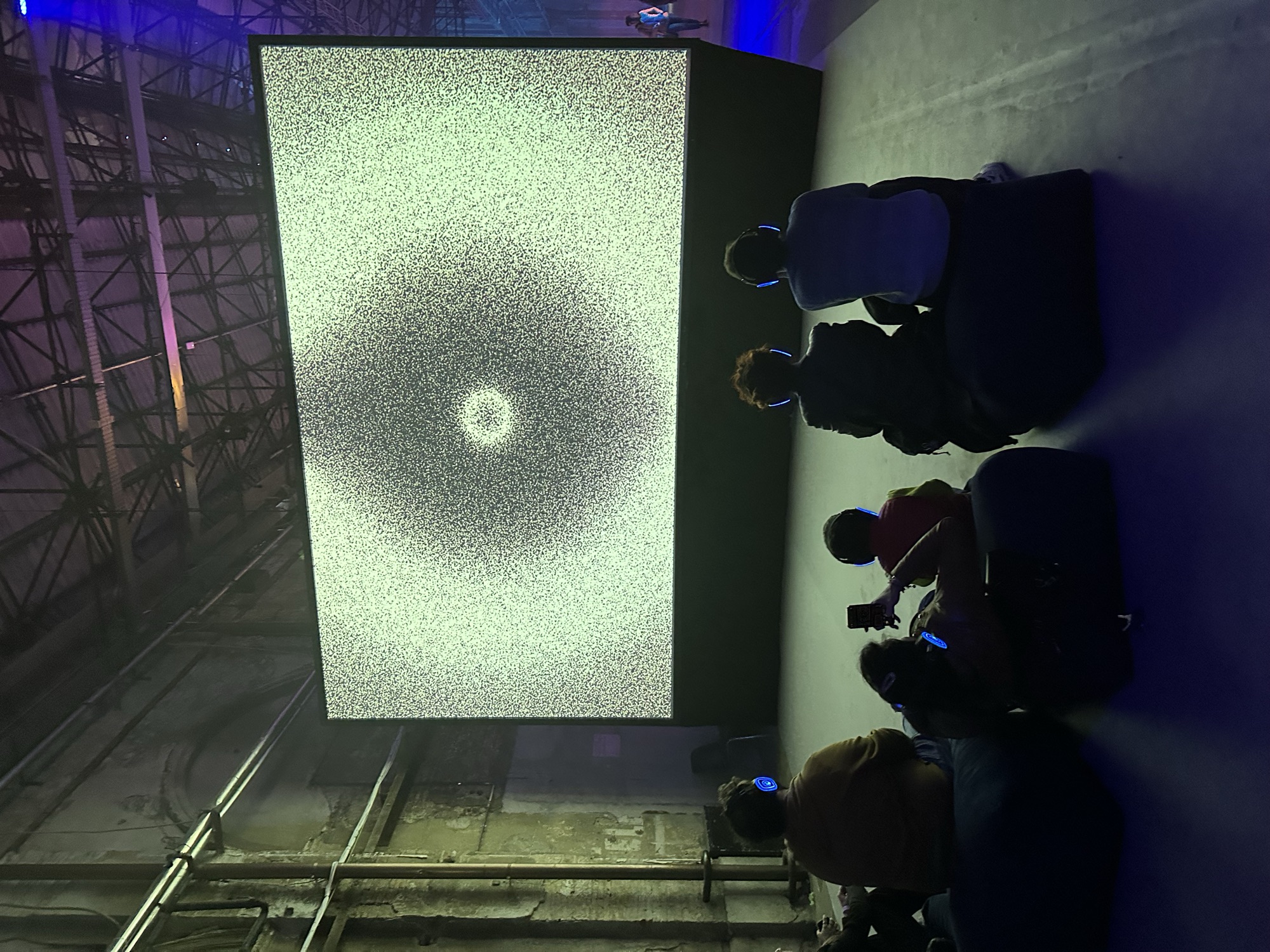
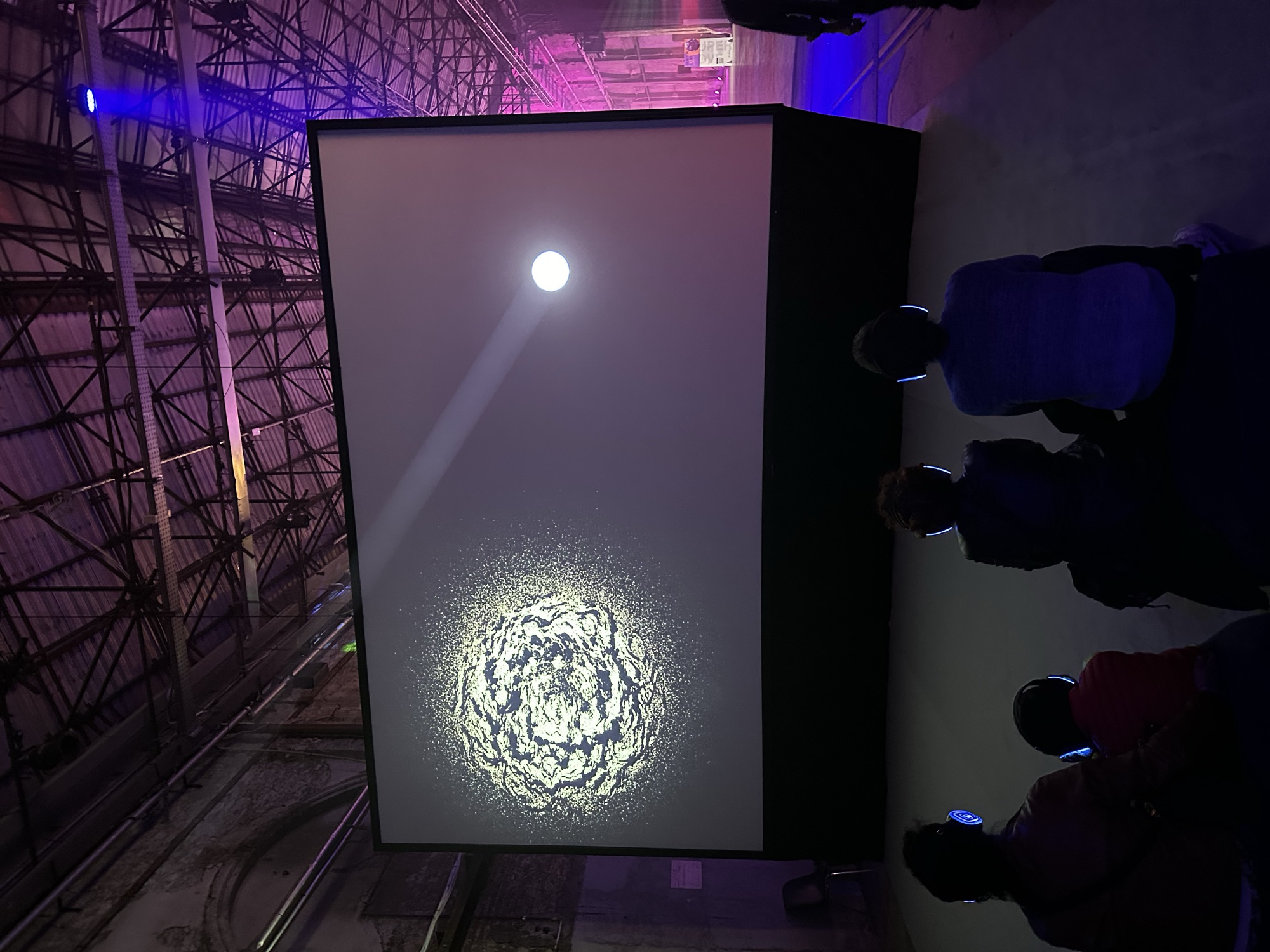
This is why the choice between a rendered film and a live generative system is never only technical. A film repeats. A system is alive, never twice the same, shaped by whoever happens to be in the room. When Inner Quadrant was shown at Bright Festival in Florence, a work about connection in a fragmented world, forms emerging, dissolving and recombining on a large screen while each viewer listened alone on headphones, in a row of people each listening alone, the medium had made the argument before the first image resolved. Together, separately. The hardware said it first.
Return
Brand experiences are, by design, for a list. Art made with the same materials can sit in a festival, a piazza, a disused factory: free, for whoever passes. No ticket, no degree, no prior reading. The technology that ordinarily filters (are you the audience we meant?) can, turned the other way, include.
There is a civic argument here, and a practical one. The public installation is where the field learns what people actually do with these things, with no brand manager standing between the work and the viewer.
The missing figure
If the materials are ready and the questions are waiting, what is missing is an intermediary. Universities, archives and museums hold the research. Creative technologists hold the means. The two rarely meet, and when they do they often lack a shared language, a budget that makes sense to both, and someone willing to sit in the middle and translate in both directions.
This is why I have started Polar, a talent studio for creative technologists. The premise is simple and, I think, overdue. Polar represents a small number of practitioners I want to work with, people who can build a system that runs and who also care what it means, and finds them projects worth their time. It introduces them to artists who need a collaborator rather than a vendor, to researchers whose work deserves a room, to institutions that hold the question but not the means. And it carries into those projects what brand work taught us: that an idea is only as good as its opening night.
The talent agency is an odd form to borrow for this. Actors and musicians have long had representation; the people who make an image respond to a heartbeat have mostly been found through a friend of a friend, two weeks before load-in. Polar is a wager that they deserve better, and that the work they could make deserves to exist.
An invitation
To those who run festivals, research groups, museums, municipalities, archives: if you hold a question, a dataset or a collection that deserves to be felt rather than only read, this is what creative technology is for. The materials are ready. The people who master them are in Milan and everywhere, and they are hungry for a better question than how to make someone love a product. Through Polar I can introduce you to them. As a producer, I can carry the work from first sketch to opening night.
Frequently asked questions
What is creative technology?
The use of sensors, machine vision, real-time image engines, generative and learning systems, projection, light and spatial sound as artistic materials, to make experiences rather than products. Less a discipline than a set of materials and a sensibility for what they can be made to mean.
What is the difference between creative technology and media art?
Media art is a field of artistic practice. Creative technology is the set of means, and the practitioners who master them, through which much media art is realised; the same means also serve brand experiences, exhibitions and live events. This essay argues for turning them toward art and research more often.
Which technologies are used in art installations?
Most often real-time engines (TouchDesigner, Unreal, openFrameworks), sensors and machine vision, generative and machine-learning systems, projection mapping and LED, spatial or headphone-based sound, and lighting or kinetic control. The right material is the one the idea asks for, chosen after the concept.
What is Polar?
Polar is a talent studio for creative technologists. It represents a small roster of practitioners I want to work with, finds them projects worth their time and connects them with artists, researchers and institutions who need a collaborator rather than a vendor.
How can a festival, research group or institution commission a work, or find a creative technologist?
Bring the question, the dataset or the collection, not a technology wish-list. Through Polar I introduce you to the practitioners suited to the work; as a producer I translate the idea into an experience, choose the materials and carry the production from first sketch to opening night.
How much does a creative technology art installation cost?
Less than most institutions assume. A real-time generative work can run on one computer, one display and a sound system; costs scale with venue, duration, robustness and the number of sensors or screens. The expense lies in the idea and in the time to test it. A brief yields an honest estimate.
A question, a dataset or a collection that deserves a room? janabjelicadesign@gmail.com · polartalent.it
Also on the blog: What a creative producer in Milano actually does.